 By Bhavin Geary
Day trading is one of the most fast-paced, intellectually demanding, and potentially lucrative endeavors within the financial world. Unlike long-term investing, which relies on multi-year macroeconomic trends and corporate fundamentals, day trading requires capitalizing on intraday price fluctuations. A typical day trader opens and closes positions within the span of a single trading session, ensuring no exposure to overnight market risks.
Because the margin for error is razor-thin and decisions must be executed in seconds, relying on intuition or basic retail banking apps is a recipe for failure. To survive and thrive in this highly competitive arena, you must approach day trading as a business. In any business, your output is heavily dependent on the quality of your infrastructure. Equipping yourself with the right tools ensures that you can analyze market data accurately, execute trades efficiently, and manage capital risk systematically.
1. High-Performance Hardware and Network Infrastructure
Before diving into specialized trading software, you must ensure your physical foundation is robust. Day trading places significant computational strain on your computer due to the massive volume of real-time data streaming in simultaneously.
Processing Power and Memory
Your trading computer needs a modern, multi-core processor to handle charting software, scanners, news feeds, and execution platforms without freezing or lagging. A system lag of just two seconds during high volatility can result in slippage, which is the difference between the expected price of a trade and the price at which the trade actually executes. Aim for a minimum of 16 gigabytes of random access memory, though 32 gigabytes is preferable for running multiple intensive applications smoothly.
Multi-Monitor Setups
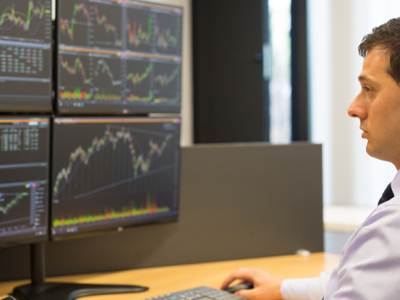
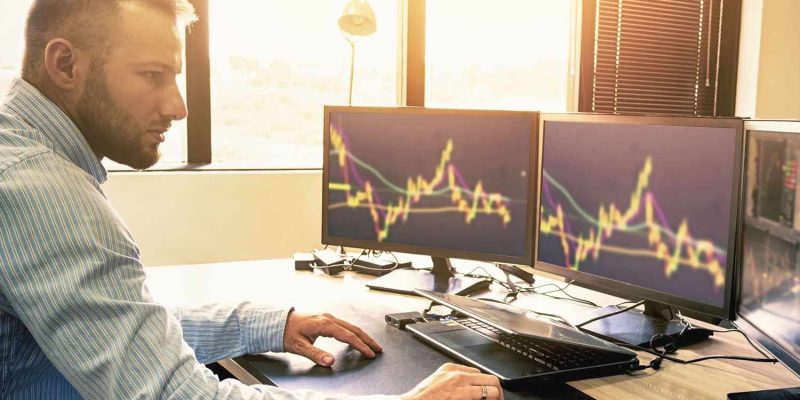
While it is technically possible to trade from a single laptop, doing so severely limits your situational awareness. Successful day traders typically utilize at least two to four monitors. This visual real estate allows you to keep your main charting software, a dedicated stock scanner, a real-time news feed, and your order entry window open at all times without constantly switching tabs.
High-Speed, Redundant Internet
A stable, hardwired internet connection via an Ethernet cable is mandatory. Wireless connections are prone to packet loss and latency spikes, which can disrupt your order execution. In addition to a high-speed fiber or cable connection, professional traders often set up a secondary redundant connection, such as a mobile hotspot or a secondary internet service provider, to ensure they can exit live positions if their primary network fails.
2. Direct Access Brokers
The selection of a broker is one of the most critical decisions an aspiring day trader will make. Conventional retail brokers are optimized for long-term investors or swing traders who prioritize zero-commission trades over execution speed. Day traders, however, require a direct access broker.
Direct access brokers bypass intermediaries and connect your trading platform directly to major stock exchanges, electronic communication networks, and dark pools. This infrastructure yields several distinct benefits:
-
Sub-Second Execution Speed: Orders are routed directly to the market, drastically reducing the time it takes to fill an order.
-
Route Customization: Experienced traders can choose exactly which exchange or network handles their order, allowing them to capture exchange rebates or optimize for the highest probability of a fill.
-
Deep Liquidity Availability: Direct access platforms provide transparent order books, allowing you to see exactly how many shares are waiting to be bought or sold at specific price levels.
While direct access brokers usually charge volume-based commissions or platform fees rather than offering free trading, the savings achieved through superior order execution and reduced slippage easily outweigh these operational costs.
3. Real-Time Charting Software and Level 2 Market Data
To spot intraday trends and patterns, you need an advanced charting platform. These platforms serve as your primary analytical lens, translating raw numbers into visual data that can be interpreted at a glance.
Technical Analysis Tools
Your charting software should offer highly customizable timeframes, ranging from daily charts down to one-minute or even tick charts. It must support a comprehensive suite of technical indicators, including moving averages, relative strength index, volume-weighted average price, and Bollinger bands. The capability to draw support and resistance lines, Fibonacci retracements, and trendlines cleanly across multiple charts simultaneously is a fundamental requirement.
Level 2 Market Data
Standard stock quotes, known as Level 1 data, only show the current highest bid and lowest ask price for an asset. For a day trader, this is insufficient. Level 2 data exposes the order book, showing the specific market makers and institutional players bidding for or offering shares at various price points beyond the immediate best bid and ask. This window into market depth helps you gauge the true supply and demand balance, revealing hidden institutional buy walls or heavy selling pressure before the price moves.
4. Real-Time Scanners and Screeners
There are thousands of publicly traded equities, cryptocurrencies, and derivative contracts moving simultaneously every second the market is open. A human cannot monitor all of them. Trading scanners and screeners act as automated filters, constantly searching the entire marketplace for assets that meet your exact strategic criteria.
A professional scanner can be programmed to look for specific variables in real time, such as:
-
Unusual volume spikes compared to the historical average.
-
Stocks experiencing sudden price breakouts or breakdowns.
-
Specific chart patterns forming on an intraday basis.
-
Assets with low float, meaning a limited supply of tradable shares, which often leads to higher volatility.
By leveraging real-time scanners, you can narrow down thousands of options into a dynamic watchlist of three to five highly actionable ideas each morning, saving time and preventing decision fatigue.
5. Instantaneous Financial News Feeds
Intraday market movements are heavily driven by catalysts, including earnings reports, macroeconomic data releases, regulatory decisions, and breaking geopolitical events. By the time a news story filters down to mainstream consumer media outlets, the market has already reacted, and the trading opportunity has passed.
Day traders utilize dedicated financial news feeds, often referred to as squawk boxes or low-latency audio news services. These platforms employ specialized journalists who scan corporate wires, regulatory filings, and social media channels to read out critical headlines or text alerts the exact second they break. Having an audio news feed allows you to keep your eyes fixed on your charts while staying instantly informed of the underlying catalysts driving sudden volume surges.
6. Trading Journals and Analytical Software
Many aspiring traders put massive effort into finding winning strategies but completely neglect the administrative side of their business. A trading journal is an indispensable tool for long-term survival and professional growth.
Manually tracking your trades in a basic spreadsheet is a good start, but modern digital trading journals automate the process by syncing directly with your brokerage account. These platforms do not just record your wins and losses; they provide deep statistical breakdowns of your trading behavior.
A sophisticated trading journal will track metrics such as your average hold time on winning versus losing trades, your performance by specific days of the week or times of day, and your profit factor across different asset classes. This data-driven approach removes emotion from your self-evaluation, showing you exactly which setups are genuinely profitable and which behavioral habits are draining your capital.
Frequently Asked Questions
Can I day trade effectively using a tablet or a smartphone app?
No, trading effectively from a mobile device is highly impractical for professional day trading. Mobile apps lack the necessary processing speeds, do not provide advanced multi-chart configurations, and limit your view of real-time Level 2 market depth data. Furthermore, cellular networks present high latency risks. Mobile devices are acceptable for monitoring open positions or executing emergency exits if your primary computer setup fails, but they should not serve as your primary trading interface.
What is the difference between a scanning tool and a charting tool?
A scanning tool is designed to filter the entire stock market in real time based on quantitative criteria to find assets that are moving or exhibiting specific statistical characteristics. A charting tool is used afterward to conduct deep technical analysis on a specific asset that the scanner flagged. Scanners help you locate where the action is happening, while charts help you plan your precise entry, exit, and stop-loss levels for that specific asset.
Why is an audio squawk box preferred over reading text-based news headlines?
Audio squawk boxes are preferred because they preserve your visual focus. Day trading requires your eyes to be locked onto charts and order entry windows where price action unfolds rapidly. If you have to pause to read text articles or scroll through a written news feed, you lose precious seconds of visual tracking. An audio feed allows you to process breaking news cognitively while your eyes and hands remain actively engaged with market charts.
Do I need to buy expensive proprietary indicators to be a profitable trader?
No, you do not need proprietary or expensive custom indicators. The vast majority of professional day traders rely on foundational, widely available indicators such as volume, volume-weighted average price, and simple or exponential moving averages. Because thousands of market participants look at these standard metrics simultaneously, they often function as self-fulfilling prophecies, making them highly reliable for predicting short-term intraday momentum.
How does a direct access broker differ from a standard retail brokerage firm?
A standard retail broker typically routes your order through an internal system or sells your order flow to wholesale market makers who execute the trade for you, a process that can introduce minor delays or less-than-optimal fill prices. A direct access broker provides a direct digital pipeline straight to the major stock exchanges and electronic networks, giving you complete transparency over where your order is routed and executing it with minimal delay.
What is the purpose of using a simulated trading account before using real capital?
A simulated trading account, often called paper trading, allows you to practice using your hardware, charting platforms, scanners, and execution software using live market data but with virtual currency. This tool is essential for building muscle memory, testing your strategic rules, and mastering the technical aspects of order entry without risking actual capital. It bridges the gap between theoretical knowledge and live-market execution.
Is it necessary to pay for co-location services as an individual retail day trader?
No, co-location services, which involve placing your physical server inside an exchange data center to reduce latency down to microseconds, are not necessary for retail day traders. Co-location is a tool utilized almost exclusively by high-frequency institutional algorithms and automated quantitative funds. For a manual retail day trader executing positions based on visual chart setups, a standard high-speed broadband connection provides perfectly adequate execution speeds.